

“What have the Romans ever done for us?”
“Hard distinctions make bad philosophy”
— John McCarthy
~ ~ ~
I believe there are vital health reasons to avoid a vegan diet, but that is not the subject of this post. Instead, I want to inspect two ethical claims made by vegans:
Environmental: Creating meat, eggs, or dairy calories is ecologically worse than creating non-meat/eggs/dairy calories, so we should only eat the latter.
Animal Welfare: Eating meat, dairy, or eggs causes animal suffering, which should be avoided, so we should not raise these animals.
You can imagine stricter or looser versions of these, and I don’t think they are the only claims, just common ones. Taken together with some other beliefs about health, a common vegan position is that since eating animal products is unnecessary, it is unethical.
Even the casual reader of ethics and moral development literature has seen the suggestion that most people do not arrive at their own beliefs via argument. Instead, people tend to copy opinions from parents or peers, developing moral intuitions based on these and a background of culture1. In other words morals are almost always organic intuitions, rather than rational arguments, and any arguments are usually backported later. People do try to convince others of their views, so arguments are still quite common, though since they are so rarely essential to one’s moral reality, they tend to be inconsistent in quality.
I want to critique these vegan claims, but my point is not to offer a direct contradiction. Rather my hope is that you might revisit some of your own intuitions that are farther upstream, if only to clarify why you think what you think.
I should mention that I am not a typical consumer: In the past I have raised chickens for eggs, and ducks and geese2 for meat. I buy the expensive milk at any store, or cow and sheep milk from local farmers. Much of my beef comes from specific farms in Maine. I think that middle-class-and-up people over economize on one of the most important aspects of human (and animal) health, and that anyone reasonably well off should consider spending much more on food than they do.
Onto the claims.
Environmental Arguments
It is worth a reminder that creating any food at scale involves both death and environmental impact. It is commonly noted that a lot of mice, porcupines, snakes, fawns, frogs, etc. are killed as incidental bystanders in the preparing and harvesting of almost any row crop. Less commonly noted is the more intentional killing, for instance Australian farmers successfully kill ~40,000 ducks a year to protect their rice crop. Australian pea farmers poison millions of mice to protect their peas, with total mice poisonings during “plague” years reaching to the billions3. UK and US farmers kill hundreds of thousands of deer to protect their crops, and in the US farmers and the USDA’s Feral Swine department kill over 100,000 wild pigs/boars yearly. These are examples of crop pests which are killed so that we may eat grains and legumes. Suffice to say it is an incomplete list! I only want to be certain the reader understands that there is no harvest of any crop at scale that does not destroy animals, often intentionally. And there is, of course, ecological impact to growing anything at all and transporting it. Lettuce in New England is shipped from Arizona, oranges from Florida, olive oil from Italy, palm oil from Indonesia, coffee from Brazil, wine from Australia, and so on.
A common vegan reply to these reminders of animal death is to point out that the calorie efficiency is in the vegan’s favor: corn or soy grown to feed a human is necessarily more efficient than growing the same matter to feed a cow or a chicken, so by skipping the intermediary, we can reduce total deaths. This is worthwhile to bring up, but as soon as the argument hinges on efficiency, we have to investigate the nature of that efficiency and its comparisons.
It’s fine to say that eating beef is an inefficient use of agricultural inputs compared to eating corn/soy directly. But if all agriculture has some ecological impact, and kills some animals, then consuming any food made with zero nutritional value is necessarily worse ecologically than eating meat. Anyone partaking in wine or whiskey, for instance, is killing more animals per unit of nutrition than a person eating a cow, since they are opting to consume products that have effectively zero nutrition4. The same goes for most vegetables, condiments, garnishes, and so on. If efficiency is the load-bearing principle of the environmental argument, then one could be a lot more ecological about their eating than cutting out meat. By one definition meat is not a necessity, and by the same definition neither is wine, coffee, mustard, cucumbers, chocolate, pickles, mushrooms, and so on.
Here the vegan might protest via an appeal to incrementalism: Taken all together, all the alcohol, coffee, cabbage, soy sauce, hot sauce, tomatoes, celery, etc, that’s still at the most generous, maybe 10% of the acreage dedicated to animal feedstock. By cutting out one big thing (meat), the vegan is being more ethical than doing nothing.
But meat has some nutritional value (I would argue quite a lot), and these things have next to none, or nothing you couldn’t get from other, denser staples. And if the ethical principle is one of efficiency, the vegan is still killing field animals, deforesting the Amazon (coffee), etc. If eating animal products is unethical because its unnecessary and harms the environment, the coffee-enjoying vegan is building careful distinctions not out of moral principles, but out of regard for their own pleasure.
The details of ecology arguments are not symmetrical, they vary greatly by place. Imagine an Irishman has a choice between eating beef versus eating prepared vegan foods that contain palm oil. Which is more ecological? The beef comes from Ireland, where cows have been maintaining the landscape for over 6,000 years. The palm oil does not. It might come from Indonesia, where palm plantations are accused of destroying tens of thousands of hectares of orangutan habitat. Which is the ecological choice for the Irishman?
One might say “Well neither, but a third thing: potatoes grown in Ireland”, but note that’s not the calculus that vegans are positing. They are making an argument that meat (or eggs or dairy) is always the ecologically bad choice, compared to any other choices. If it is an ecological argument, it is one that lacks any sensitivity to context. “Premise: be ecological. Conclusion: don’t eat meat.” fails often in the specifics. The vegan seems to do this by imagining their own diet (and any footprint it has) ideally, while holding other people’s to reality, which is a very common slight-of-hand in arguments but is especially grave in a moral one. There are many places in the world where meat grows quite well, where the grazing animals are actually efficiently using scrubland and otherwise difficult to farm areas, and where they have even been maintaining the ecology for millennia. Not every alternative to that is a straightforward ecological choice.
None of this means that the premise is wrong, meat does have a certain ecological impact, but that the conclusions are so low context that they miss the reason why one should care. There are even places where meat is the most efficient use of land. In a place like Iceland, its one of the only uses: Iceland is totally self-sufficient in meat, eggs, and dairy, but imports 99% of its grain. Would an environmental vegan traveling or living there switch to an environmental carnivore? Ireland is similar, being an exporter of beef but an importer of nearly all other food (about 80% of total).
The vegan may balk that these islands are awfully unique, so let’s look at America, which has its own interesting ecological context. You may find vegans sometimes claim that animal agriculture is 12-20% of total global emissions, but this is largely because the high global number is impacted by land use changes in the global south, like Amazon rainforest deforestation. In the United states, animal agriculture is just 4.3% of total emissions. That’s much less than travel for pleasure, which for Americans is around 7%!
America is one of the places where meat grows quite well, largely because our ancestors converted a bison herd into a cattle one as we took the nation westward. (In case it is not known, in the US, about 80% of beef cattle’s life is spent on pasture.) So today, we happen to have a biomass of cattle that is nearly equivalent to the bison, shepherded for the American civilization. It also happens that more than half of animal ag emissions in the US are chalked up to ruminant enteric fermentation, something that the former biomass of bison were already producing. Many environmental groups say that we need heavy ruminants to maintain the western lands, so this enteric fermentation could be taken as an ecological baseline. With that baseline, the animal agriculture emissions are much lower than just 4.3% of US emissions, closer to 2%.5 If one is faced with the decision to be incrementally more ethical by reducing emissions, an American who stops flying and becomes an omnivore ends up considerably more ecological.
So if one believes eating meat is unethical because of its inefficiency, and give it up, then one must concede that someone giving up travel (or air conditioning, or heating their home very much) is actually more ethical. Meat is simply not a large source of emissions compared to these alternatives in the US. If these can only be met with “oh well”, it makes the ethical precept less sincere. It suggests there’s really some other moral intuition in the background that’s being followed, rather than the argument.
Some environmental vegans may still bemoan the inefficient land use of cattle, but nonetheless:
In temperate or colder climates, or mountainous areas, much of what animals eat is not suitable for human consumption and would otherwise go to waste. Ruminants eat considerably from pasture that is considered otherwise marginal farmland, turning it productive.
We have a lot of land here in America.
That was the land’s prior use! The cattle continue an ecology that supports all kinds of wildlife, unlike the significantly less natural ecology of row crops, or like growing peas in Australia, or lettuce in Yuma. In the US about 82% of grazing land is rangeland, which continues to support the natural ecosystems (prairies, shrublands, steppes, etc).
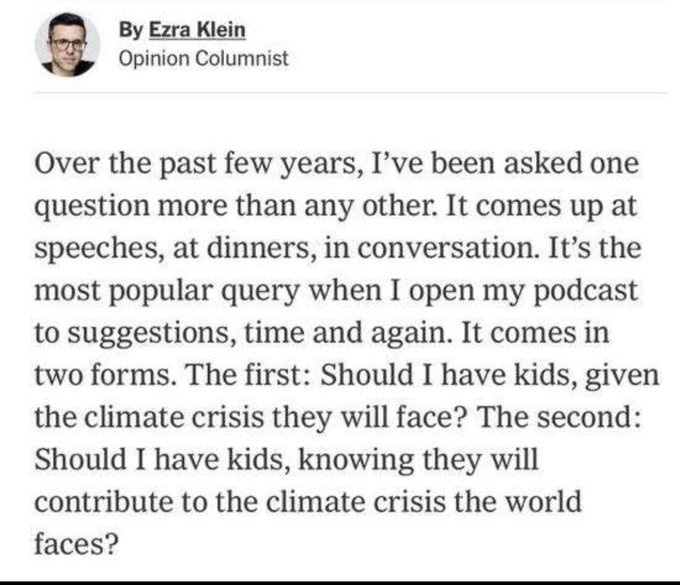
The vegan could still say we should unwind this, that it belongs to bison and not to civilization, we should leave the area completely. Leave the continent for that matter, maybe the earth. This sounds like I am typing out a reductio ad absurdum but you can find a number of vegans who realize that once you start an argument with an “efficiency” premise, the conclusions extend quite far. If the concern is rainforest destruction, why not advocate for veganism in the global south, but not in Ireland, England, the European plains, America, Iceland, New Zealand, and the Asian steppes? In fact why not evacuate the tropics? And why have children at all? I don’t think I’ve heard a vegan advocate for abandoning the tropics, but “have fewer/no children” is a common argument stemming from the same premise. Common enough that Ezra Klein put it as the most common (!?) question put to him:
~ ~ ~
At some point you have to doubt the low-context premise. What is the efficiency for? A person who truly believed the efficiency argument — that something made for human consumption should be stamped out because it may not always be most efficient — will ultimately find themselves at misanthropic ends. We see this in the people who advocate for having no children for the environment’s sake, but we also see it sometimes in the views of former-vegans, who realize they were running with an argument that lead to self abnegation. An example from last year:
Veganism was a form of aspirational self-erasure for me. I thought it was wrong for me to exist, and wanted to minimize the impact of said existence.
"I won't travel because flying is bad," "I won't get takeout because plastic is bad," "I won't have kids because people are bad," etc. The conclusion was always that I shouldn't be here at all. I'm sure some people agree with that, but it's not how I want to live anymore.
— Callan
I must reiterate that most people are rarely persuaded by arguments, really they have moral intuitions that are doing work in the background. People might not be able to articulate well why they do or don’t feel bad eating meat, but the reasons are likely different from what they would say if forced to justify it on the spot. Being able to construct an argument is not proof that the argument is really what you believe, or that it’s more coherent than a person with moral intuitions who has never articulated what they believe. To have learned something and to be convinced of something are two different things.6
I think Callan’s comment is clarifying. It’s easy to construct a strict argument that seems believable (that is, you think you believe all the premises wholly), but you don’t actually believe it. The more our egoism is satisfied with a result, the more robust our beliefs. The more we build up or backport a belief from arguments, the more we might make it push us in directions we should not be going. We can inadvertently use rationalism to fail our moral intuition. This pattern of careful or consistent argumentation overriding intuition is more (intentionally, and frequently) common in cults, but its also possible to do it to ourselves, like in Callan’s case. An argument with minor flaws at the beginning becomes sincere, and as the conclusion is pushed, it loses all connection to the underlying moral intuitions it hoped to justify.
Animal Welfare
There is the question of animal welfare and suffering. That is, whether a particular animal has a good life, an acceptable death, and if it is better to live at all than to not be born. Vegans will often say that their position is one of harm reduction: modern industrial farming involves horrific practices, therefore we should not eat its products. It’s not hard to find videos of the worst abuses of say chickens in unwholesome quarters, to put it mildly.7
But since the cow is cited as the biggest environmental culprit, and is arguably more sentient than a chicken, let’s pull on that thread a little longer. I think a lot of people don’t know the lifecycle of a cow, or have only seen animal welfare documentaries that are uncharitably slanted, if not also out of date.
I should mention, in case its not commonly known, that about 90% of US beef farmers raise 100 or fewer cattle at a time, with the median in this set being about 20 cows per farm (46% of all beef cows come from these small operations). If the small farm doesn’t finish them, they sell them at a regional livestock auction to a buyer that will take a larger group to pasture (if light) or to a feedlot (if heavy). I’m simplifying slightly, but that’s roughly how it goes. Throughout its life, a cow will spend 70-80% of its life in pasture, either rotated through fields or the open space of the American west. In countries like Ireland or New Zealand, this number can be higher, often 100%, especially for sheep which do not benefit from getting finished with grain. When feedlots are used, they’re for the “finishing” stage.
If you’ve only ever read of feedlots and never seen one, I encourage you to take a look on the ground level. Here’s a typical (mid-size, Iowan) family farm with their own feed lot [youtube], recorded by someone in the family who just wants to show you around and how their setup works in the middle of winter. Winter is not exciting for a ruminant, but these are not unhappy cows, and this farmer is proud of his family’s setup. Here’s their herd in summer on pasture [Instagram].
You should also view the largest operation in America (they claim the world), here’s a short video [youtube] of Five Rivers Feedyard. Or see their site. The video is promotional, but targeted towards owners of cattle herds.
These are not idyllic places, they aren’t the Shire (though in real life, the Shire was filmed in Matamata, New Zealand, on a sheep farm!). But cows don’t have the same aesthetic quibbles we do, nor do they get bored in the same way as us, so take care not to impose your mental mapping onto their existence. Much of a cow’s life is this:
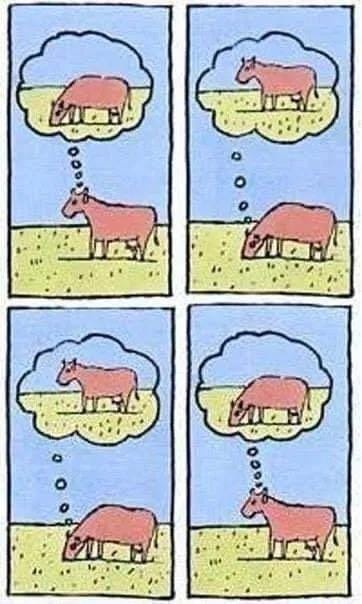
Even in the feedlot, these cows are generally happy and sociable. The American cow lives a life as free as possible from pestilences, predators, hunger, and stress as much as possible. Even their day to day crowding is less than what many New Yorkers put up with willingly.
It is worth thinking carefully just how cushy this is. I don’t think its an exaggeration to say the modern American beef cow lives a better life than most humans for most of history. You might say that’s a low bar, but remember, we are talking about whether or not their lives are worth living, and if you think that’s a low bar then you also think that most humans for most of time had lives that were not worth living. I and your ancestors disagree.8
I don’t think most vegans appreciate just how much better the life of a cow is than a life in nature, where fear and hunger dominate, even for many predators. When a bison is hunted, it dies by a pack of wolves hounding it in heavy snow drifts, bleeding out from having its balls bitten off slowly over the course of a sometimes multi-day standoff. The bison will eventually die of exhaustion or blood loss, stressed and in fear. It could be old, but its more likely a young one that the wolves were able to isolate, while an outnumbered mother might helplessly try to fend off the predators. After the successful kill, if there aren’t enough wolves, a bear waiting nearby might bully the exhausted wolves and take the meal for himself.
Nature is a rapacious place. We have genuinely made a nice life for cows and sheep. I think at the levels we’re talking about, humans actually get considerably more stressed out than cows, going through many harrowing life experiences, bullying for years, victimization, etc. Feedlots are boring but the average office or warehouse worker may have less aesthetic quarters than the average cow. The humans may also get less sun. All this to say: It is not hard to imagine a fairly stressful human life, and we do not claim that it is not worth living, so I think it unfair to claim this of the cow.
Some vegans balk at the unnatural-ness of the cow’s life, which I find to be a silly objection. The modern cow cannot exist well in nature9, but neither can the modern man living who lives in Bushwick survive in the bush.
Ultimately, cows are still killed by us, but this is unknown to them. They no more know the day of their death than the man from Bushwick (or any of us) does. We might have a better idea, but cows do not study actuarial tables.
Vegans may claim that not all animals have it that good, and this is true, but if that’s the objection, then the onus is on the consumer to spend more and source better, and omitting meat is not a clear conclusion. My own chickens certainly had enviable lives compared to all the forest animals that wanted to eat them. It’s of course fine if most vegan arguments actually are arguments against factory farming, but it materially changes the conclusions of how to live one’s life.
Consuming the cow
If after this reflection the vegan still thinks it more ethical to not eat animal products, there’s another small problem just out of view — not eating the meat but consuming every other part of the cow. About 50% of the cow’s weight becomes beef, the rest becomes inputs for pharmaceuticals, cosmetics, car tires, glue, fire extinguishing foam, surgical sutures and hemostatics, cellophane, antifreeze, plywood (the glue comes from albumin, did you know your house is made of cows?), industrial lubricants, and so on. Then there is bonemeal and bloodmeal, for organic fertilizers. In fact, if a vegan is eating small-scale or homegrown organic vegetables, there’s a good chance they’re eating a bit of the cow once-removed.
And of course there is the byproduct of manure, to act as fertilizer and soil amendment. Unlike synthetic fertilizers, manure improves the soil tilth to reduce erosion and retain moisture. Even if you decline to eat meat, you are likely benefitting from the cow regardless.
This is ecologically fine, of course. It’s good that we use the entire cow and its byproducts to make things and build soil. But if someone is claiming that they are more ethical because they are abstaining from eating meat, yet they are not abstaining from using the other half of the cow, it strikes me as taking credit for an ethical stance that they aren’t actually completing.
An adjacent incompleteness arises with pets like cats and dogs. These pets are unnecessary in the sense that eating meat is called unnecessary. But many vegans keep pets not out of necessity, but for pleasure, and their pets eat meat. If meat consumption is an ethical concern, how can this be reconciled? If someone wants to reduce animal suffering, except they like having a dog, that pleasure seems less defensible than someone eating meat on the grounds of human health. If it is a principle, it is one that bends as soon as the suffering is just slightly out-of-view. It implies there are other principles at play, that their real moral intuitions are not captured by their arguments.
One must wonder what the moral intuitions are that allow vegans to own a carnivore without moral compunction. I suspect it stems from an intuition where one considers themselves as separate, or entirely outside, of the circle of life. It would be unwise (and unfair) for me to speculate too much on other’s intuitions, but I suspect the rejection of humans as part of nature is a somewhat common starting precept, and not just among vegans.
~ ~ ~
Lastly it should be noted that the ecological argument and the animal welfare argument are often at odds with each-other. People intuitively like small farms (and I personally think they should), which often treat animals much better, but they are often impeccably inefficient compared to mass agriculture. For the six years I have raised chickens they have been free ranged and also fed on the sumptuous kitchen scraps of toddler leftovers, parmesan rinds, berry and fruit trims, and so on. When a coyote or fox was able to eat one, it may have been the best meal they ever had, also. It is unquestionable that these chickens had better lives than ones raised in battery cages, but also that my back yard is not the most efficient way to produce eggs.
I think most people intuitively think it is OK to sacrifice efficiency, sometimes great efficiency, to give animals a better life and higher welfare.10 But note how close this comes to the end aim of the human argument. If its good to be less efficient to make a chicken’s life better, why not a human’s? An obvious objection to the efficiency argument is animal, or rather human, or whole civilization welfare. I hope what Callan eventually intuited is that efficiency is only ever instrumental to our goals.
What has the cow ever done for us?
To me the intuitive response is to be deeply grateful to these animals. So long as we are part of nature, with inescapable cycles of life and death (for growing crops, or meat, or fertilizer, or cat food) — gratitude is more morally productive than guilt, which if it does not descend into self-abnegation, can descend into haughtiness. The vegan who owns a cat or eats crops grown with manure is more morally incomprehensible to me than than the beef rancher who loves her cows.
We have a well developed cultural morality. We gain an intuitive disgust at killing, at filth, an appreciation for sterility, and so on, because we are so civilized. At the same time, our self-domestication may be something of a failure mode if it separates us too far from nature. We lose an appreciation of our place in the world and for the visceral parts of life in general.
To me there is an understanding of civilization, and of nature, that gives an appreciation of just how humane we have made our corner of nature. We are the only creature that pities our food, that tries to ensure they live lives free from stress or hunger. Nature beyond our control is much more a place of desperation than that. It is worth reiterating that the cows we bring along for civilization are creatures we have admired and tried to treat well — better than nature — for thousands of years. Despite the many hiccups of large-scale modernity, their lives have mostly gotten better. It is not necessary that we eat them, but it is necessary that we partake in nature, and I do not think a total separation of ourselves from the natural world is more sensibly moral. We kill them, but all creatures must die. What is rare is living well at all, and we should strive to give the cow, who has triumphed over nature’s desperations alongside us, a fitting civilized life. So it is with dogs and cats, for much the same reasons, who also must eat. So it is with the crops that will end with us poisoning mice. Civilization is trying to garden at a grand scale.
This understanding is of course far from an argument. It is much farther upstream, bound up in how one sees the world. My wellsprings remain in the distance. But you can still visit your own.
Good night,
ss
~ ~ ~
For taoki, Avital, and Chris
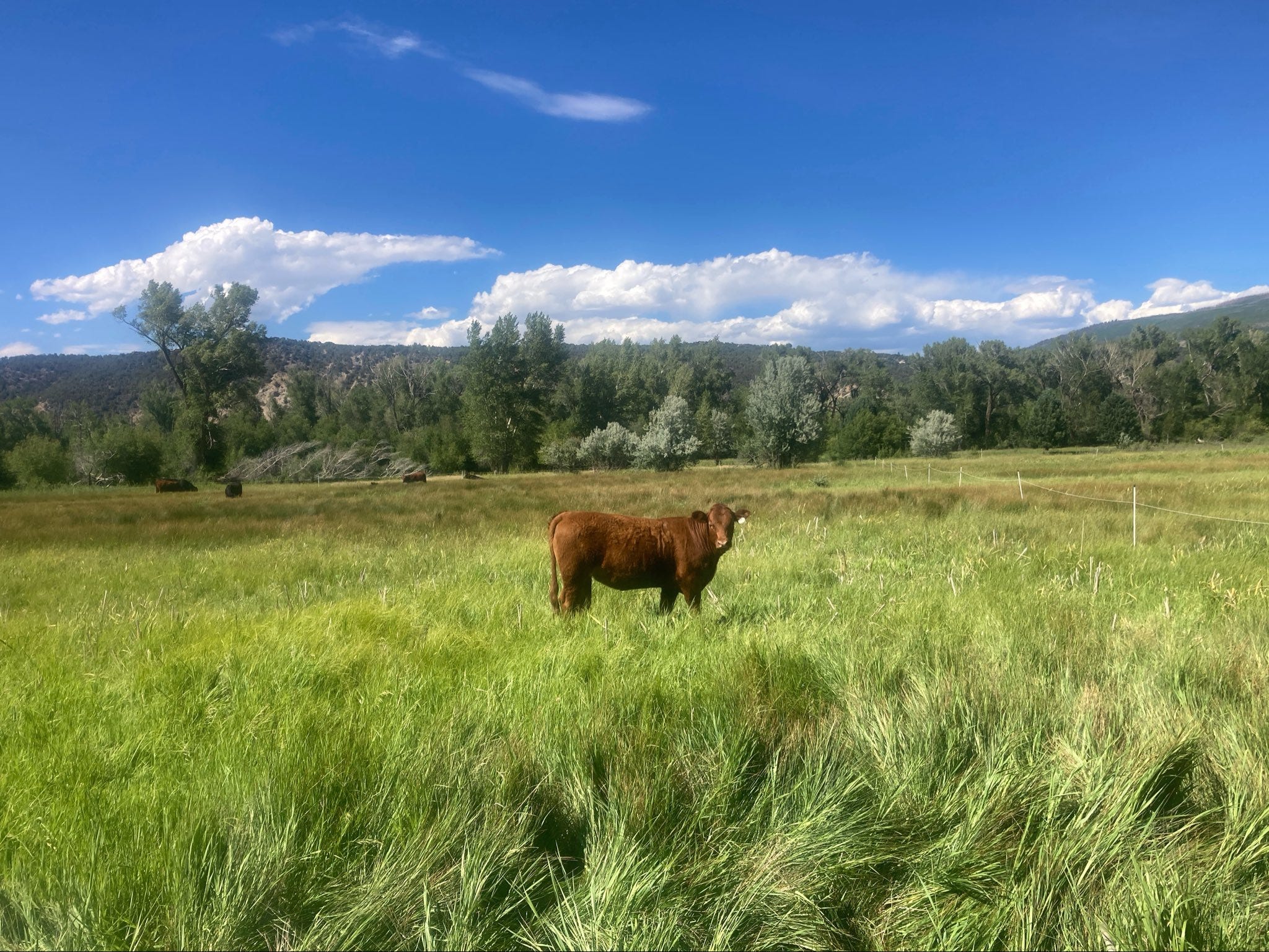
The photo of cows in pasture is from Alchemic Cowgirl in Colorado, June 2026.
I think this has been a common opinion since at least Emile Durkheim in the 1920s, arguing about moral facts as socially transmitted. Piaget probably said something similar, or maybe I’m mixing up the two.
I raised one cadre of geese for meat, but never ate them. Some other creature — likely a coyote, fisher cat, bobcat, fox, hawk, owl, or raccoon — did. While I did my best to protect them every night, a 5K race ran (and walked) by my house one day, and the young goslings took an interest, and waddled off with the runners. I spent the better part of a day looking for them, but found no sign other than the race organizers mentioning several sightings at various checkpoints along the wooded roads. It was a time of drought in New Hampshire, which makes the predators (and prey) more desperate then usual. Whichever direction they turned, it was unlikely they lasted the night. The woods are a very hungry place.
Optimistically, Mike Archer at the University of New South Wales estimates ~55 mice per 100kg of usable plant protein. Pessimistically it’s 3-4,000 burrows per hectare during heavy plague years (like 2026), with 80% poisoned, is about 10x that figure. Of course if these mice were not poisoned, they would starve after harvest. Even absent of human intervention, much of nature occurs in boom-bust convulsions of death, sometimes given names like “resource pulse” or “predator prey oscillation”.
One might be tempted to quibble that (say) wine or cabbage have some nutrition, but then the vegans are suddenly making an argument that non-vegans routinely make regarding nutrient density, which is far higher in nearly every animal product, while dodging both the efficiency argument and the necessity argument that were raised by the vegan position in the first place.
If you accept the enteric fermentation baseline from bison, elk, and deer that were “cleared” for civilization, greenhouse emissions from animal agriculture in the US are ~1.8-2.1% of total greenhouse emissions. That’s a tiny slice of emissions! Emissions from travel and tourism are ~6-8%. (All travel is ~28%) If you remove all beef from the US and don’t opt to re-add other large ruminants, conservation groups predict ecological disaster, since large ruminants are necessary for those landscapes, including their carbon storage ability. You can read a bit about that on The Nature Conservancy’s site.
Recounting Plato’s Gorgias, pistis vs episteme.
I noticed while doing research that the Wikipedia article for battery cages claims that “As of 2014, approximately 95 percent of eggs in the United States were produced in battery cages.” The figure today (twelve years since) has dropped to 54 percent. It is generally easier than ever to buy cage-free eggs (or raise your own).
Well cows can survive some places. Argentina was such a nice place for cows that when settlers arrived there with cattle, they easily went feral, created huge herds, and stayed feral for about two hundred years. There are still some small feral herds in the Pampas today.
W.H. Auden’s Ode to the Medieval Poets makes for a good reminder.
Reminded of Burke saying that economy consists not in parsimony, but in careful selection.
This has been one of your weakest posts so far. This is not an attack. I'm not saying this as a criticism of your opinion as everyone is entitled to their own but this post is rooted in a ton of assumptions especially on the morality side. It read like a personal defence for a choice you have made and are now presenting it as universally truths.
I see a data presented about farms in the US but the world is much larger than developed countries. Even then, you are looking at meat, dairy purchased and cooked in its raw forms. As a basic example, you will be surprised at how many food items in your supermarket has milk solids. To assume they all source milk from ethical sources and still meet their bottomline is questionable. Let's assume this is true in the US and Europe but most of the urban world is still a price sensitive market and for an economically backward population, the only thing that matters is the price on the label. In some of these countries, the factory farming conditions are truly horrific. I won't go into much detail other than that.
You touched on how difficult it is to avoid animal products in other markets like pharmaceuticals. You are right. It is almost impossible to avoid it but again it is a function of availability and price. After meat is sold off, the rest of the carcass is used as much as possible. The sheer ubiquity of these raw materials is what drives secondary usage. If these were unavailable, won't there be alternatives found and used? Maybe, right? It is not a certainty but there are people willing to not see the needle move in their lifetimes but still have a moral stance. You talked about nutrition so I will give another example. I think it proven without a doubt that meat has more nutritional value and that it can’t exactly be replicated with plant foods. But there are people who avoid eating animal products and live well into their old age so it is not self-harm to avoid animal products. I am not saying they are healthy compared to meat eaters but that maximising personal nutrition/well-being is not a priority over a moral stance for them.
You also spoke about how ruthless nature is and that in comparison we give animals a great life and a great death. Firstly, you don't have to do much to be better than nature so it's a bad comparison. Secondly, the animals not knowing their own death and how it came is not a good defence for the act that is being committed. Especially when something like a cow never existed in nature. They have been domesticated to the point where they have lost all ability to self sustain. By human selection, we have taken away autonomy which nature at least provided. "We kill them but all creatures must die" unfortunately does not hold up as a great argument against humans. You can't enslave a human their entire lives and give a "good life" as a good defence for enslaving it or killing it (It was done in society and is now largely considered immoral).
Nature is immensely malleable as well. I hear people arguing that it is natural for humans to eat meat. That does not automatically make it the right thing to do. Dogs evolved from pure carnivores to omnivores. Humans evolved to process cooked food after fire was discovered. We evolved to better process grains after agriculture. "Which is more natural and hence more right?" is an incorrect premise. We have the gift of cognisance, we can decide what is right and wrong.
I do have a lot more to say but let me wrap this up. It is respectable to have a position that maximising human/personal nutrition, well-being and comforts is your priority. You are comfortable with a moral stand in which you avoid all harm until it does not adversely affect humans/self. That is entirely reasonable but it has to be explicitly stated and understood. It is not a debate that cruelty against animals purely to fulfil human needs is happening at an egregious scale.
Again, veganism is also a stance just like that. Why stop at animals? Plants have a life too, why are they secondary to human or animal life? A lot of vegans I've spoken to understand this fact but some still argue.
These moral positions are a line in the sand. You draw it where you are comfortable and try to adhere to it. The whole tone of the post was that one is more right than the other which I think is wrong (hard distinctions make bad philosophy) :))
> that about 90% of US beef comes from farms that raise 100 or fewer cattle at a time
fyi, this is not accurate, you probably meant to say that 90% of US cattle farms raise 100 or fewer cattle at a time, they account for 46% of all beef cows.
idk the rest, i'm just very interested in the matthew effect (rich get richer) and how things cluster, so that sentence stuck out to me as fascinating if true. (unfortunately it wasn't)
source: https://www.aphis.usda.gov/sites/default/files/small_scale_beef.pdf page 3