

This is post may sound familiar: it is based on a 2021 post titled The Most Precious Resource is Agency. A rewrite with recommendations for children and parents was published in Palladium Magazine under this title. I am preserving it here too.
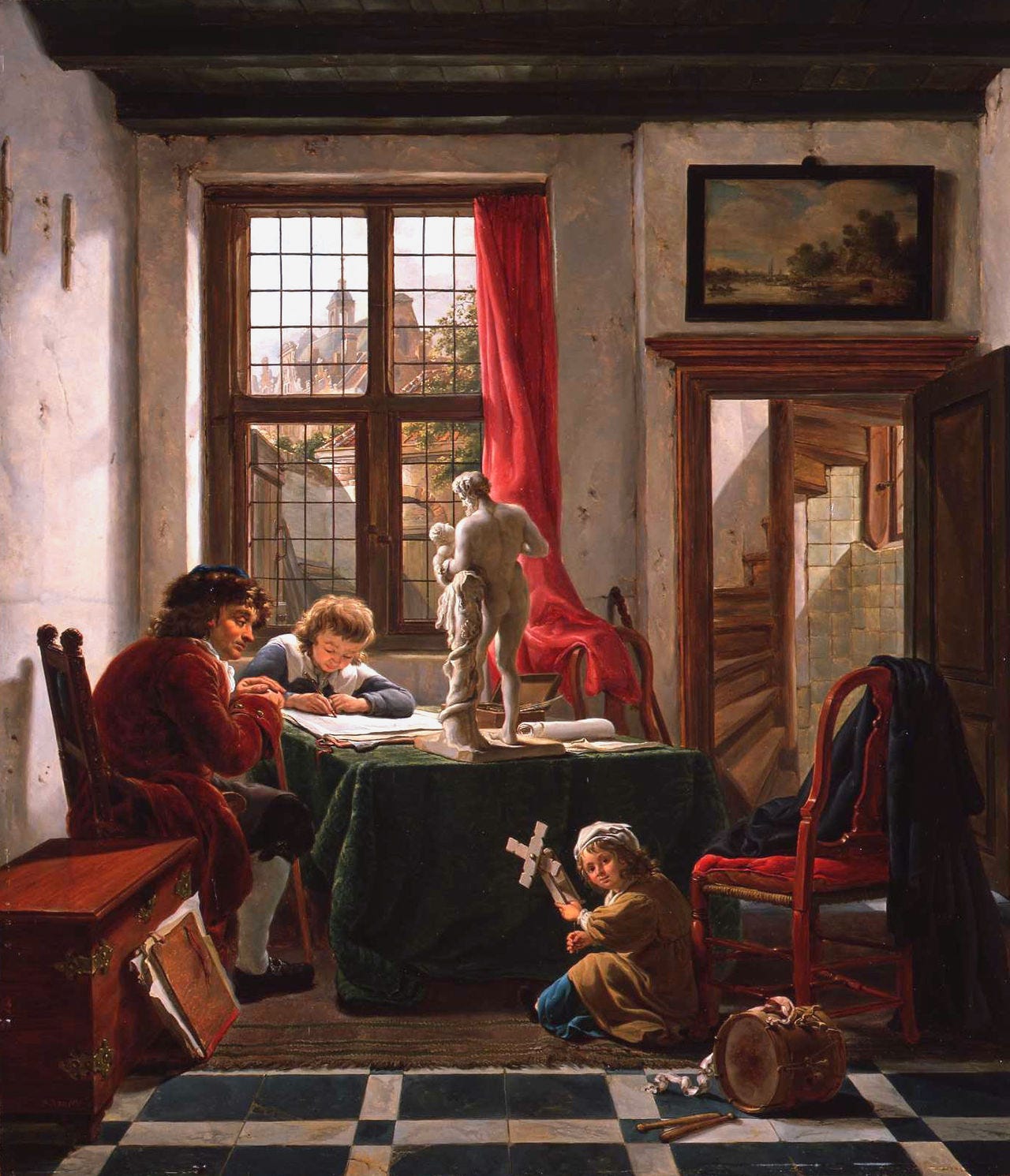
When I read biographies, early lives leap out the most. Leonardo da Vinci was a studio apprentice to Verrocchio at 14 years old. Walt Disney took on a number of jobs, chiefly delivering papers, by 11. Vladimir Nabokov published his first poetry collection at 16, while still in school. Andrew Carnegie finished schooling at 12 and was 13 when he began his second job as a telegraph office boy, where he convinced his superiors to teach him the telegraph machine itself. By 16, he was the family’s mainstay of income.
Readers (and some biographers) tend to fixate on the celebrity itself, the inflection point when people achieved fame. But their early lives often contain something more revealing than their successes. Before you grasp, you have to reach. How did they learn to reach?
In my examples, the individuals were all doing from a young age as opposed to merely attending school. And while they may not have wanted to work, the work was nonetheless something that they, their families, and society felt was useful, purposeful, and appreciated. In a sense, they had useful childhoods.
Do children today have useful childhoods?
~ ~ ~
An individual’s life can continue with an inertia that will lead them on to the next year or decade. Most young people today know approximately what they are going to be doing for the first twenty-or-more years of their life: school. Post-schooling, the inertia continues. Many a modern story opens with a worker—an office worker usually—who is so inert that he scarcely notices the passage of time until he becomes blindsided by a sudden yank of reality that forces him out of this inertia. Since we do not live in stories, we have to ask: How can we make that pull ourselves?
Agency is the capacity to act. Gaining agency is gaining the capacity to do something different from the rigid path of events that simply happen to you. Remarkable people typically go off-script early, usually in more than one way. Carnegie becoming a telegraph message boy is one opportunity; asking how to operate the telegraph is another. He was handed the first one, but he had to ask for the second. Da Vinci had plenty of small-time commissions, but he quit them all in favor of offering his services to the Duke of Milan.
No one is asked to write a book, or start a company, or stage a play, or seek invention and excellence in the unknown. These acts are very contrary to the default script. Yet they are the resources that create the world. Imagine if Carnegie and Da Vinci were instead compelled to stay in school for 10 more years. What would have happened?
Conservation of Agency
In these old biographies I find it interesting just how early and varied the avenues were that allowed promising adolescents to pivot off-script, and do something different than everyone else. For a 13-year-old today, what is the equivalent of being a telegraph office boy where one can learn technology while contributing? What about for a 16-year-old? What is today’s equivalent of becoming Verrocchio’s studio apprentice at 14?
Where are the studios, anyway?
Modern complexity has erased some avenues for agency. After all, no boy can become a telegraph operator today. As complexity grows, sometimes stepping stone are removed. But the primary problem is not technology, it is how we have oriented the world and our expectations. A 13-year-old Steve Jobs once called Bill Hewlett—whose number was simply listed in the phone book–and received a summer job at Hewlett Packard. This would be unsurprising in Carnegie’s time, was certainly surprising for 1968, and is culturally verboten today.
We have a public imagination that cannot conceive of what exactly to do with children, especially smart children. We fail to properly respect them through adolescence, so we have engineered them to be in storage, and so they shuffle through a decade of busywork. Partly, the length of schooling has increased simply because it could—because we no longer need children to work, yet need them to do something while the adults go do theirs.
The sad result of school’s length and primacy is that it ensures there is nothing in particular for children to do. Since the rigid framework demands a certain number of hours-in-school-seat, it precludes other options. The time sink of school is a kind of opportunity suffocation, it makes it more difficult to imagine what good opportunities might even exist for most children. And the longer we disallow children from having the agency to act on the world, the harder it becomes for them to visualize it in the first place. The result is that we have young adults who have a difficult time adjusting once their life-script changes even a little bit, or once it simply ends past college. The path is rigid, yet brittle.
Modern schooling began as a track to be left as soon as you found something worthwhile to do with your life. But it has since morphed into an attempt at systematizing as many years of a child’s life as possible, extending well into their adulthood. At the same time, school can never gratify the smartest pupils as much as either party would like, because they are charged with the education of everyone. The result is that many precocious children will spend prime years of their life quite literally waiting for other students to finish.
Mass schooling attempts a systematization of skill and knowledge transfer. This is not terrible for the average person, but results are predictably average—systems at scale must function with and cater to the lowest common denominator, and the process of standardization loses all sensitivity to context. Since everyone must do the same things, it is difficult for any student to do exceptional things. The result is alarming on its own for wasting people’s youth. But even worse, in having so many years of life monopolized, people come to inadvertently believe that skill and knowledge transfer are primarily the domain of school rather than a normal consequence of meaningful work.
The ever-longer march through school creates a bizarre barrier separating the student from reality. As a consequence, childhood consists of the age when one can intuit well how the world works at the same time one is prevented from acting upon it meaningfully. Instead of creating adolescences full of rites of passage where one attempts to master something and accept responsibility, we have made it full of waiting and fake work—for school is work. After a time, all children spot this fakeness, and all honest educators note it: teachers often say that one of the difficult parts of teaching is having to justify why the curriculum will be relevant and useful.
It is difficult to blame young adults for assuming that work is fake and meaningless if we prescribe fake and meaningless work for the first two decades of their existence. When meaningful work is an adult-only activity, it is little wonder that adolescence is a period of great depression. It would be surprising if it was not. Unlike the past, where many smart children finished sooner, modern education endlessly ushers them towards an often farther and more abstract future—one so far away and abstract that some children become infected with the opposite of agency. They take on a learned helplessness and downplay that the future is a reality at all.
Higher education often fails to cure these deficiencies, and some people exit academia well into their twenties almost terrified to leave. How could we celebrate a form of learning that creates something so pathetic—the opposite of a readiness for life?
The institutions of higher and lower education have a purpose, but they are not your friend. They have no sensitivity to context. Their incentives are not the same as your incentives, and they have no interest in any individual going off-script. They ask nothing of you but your time and eventually your money, but these are not trivial things. And they will take as many of your prime years as you are willing to give them. School should be leveraged only so long as nothing else meaningful is available.
This is not the worship of employment, but an observation of fundamentals: it seems that the more you ask of people and the more you have them do, the more they grow into to the task of doing it on their own. While we shouldn’t allow children to be factory bobbin boys, no one would describe Steve Job’s summer job at 13 as his exploitation.
We should be thinking much harder about ensuring children can make meaningful contributions, and we should teach them in ways that are sensitive to the context of the real world. We are not looking for a job but opportunities for mastery: learning and practice beyond the depth one would find along the common path, which demands no such thing.
Growing Agency
It might seem like the path forward is to fundamentally change the nature of schools, de-emphasize college, increase opportunities for apprenticeships, and so on. But waiting for any kind of policy daydream is a mistake. If a system lacks imagination, it is best to supply our own. History ebbs and flows with opportunity, and we find ourselves at a fortunate time.
When television first arrived, it was hailed by some as “a university in every home.” Such an optimistic prediction didn’t quite come to pass, but the internet quietly enabled something better—forms of education broader and deeper than the university.
User-generated content does not need the benefit of large audiences or the approval of large broadcasting companies. Students do not need permission to attend. In corners of the internet that are easy to miss, the biggest renaissance of informal skills transfer in history is happening right now. Unlike textbooks or professors, the creators of these educational materials are willing to engage with random students throughout the world, provide feedback, and even arrange meetups—often for free.
A close look at social media reveals ample opportunity for self-apprenticeship. We live in an era where a motivated 12-year-old can learn the basics of woodcraft, programming, or how to bake bread that would rival world-class bakeries. They can master nearly any mechanical system or any number of technical or artistic vocations, even if no mentor lives nearby. The limit is no longer some teacher or institution but a child’s own patience and interest, as well as the interested support of the parents.
Often the parents of precocious children do not appreciate this interest. They think a child engrossed in Minecraft is simply playing video games, instead of longing to build. It is the parent’s job to identify this motivation, and then leverage technology and their own resources to encourage something more meaningful. “He’s going to do great things one day.” In his thirties? Why not today?
We can somewhat excuse schools for only covering topics broadly. But if education matters to a parent, then they should think hard about how they can allow their child a deep venture. Parents owe it to children to furnish them with materials, time, and useful pursuits. Schools will not supply them, and the most common failure mode with parenting is probably giving children options along the same feeble lines, and responsibilities too close to what they already have at school.
Occasionally parents might gesture towards an activity, like a lemonade stand on the sidewalk, to gratify a child’s interest. This is the archetypal poor choice: A lemonade stand does not teach the value of money but how to wait and occasionally beg. To understand business or food or hospitality, children would be better off trying to make something people really wanted.
For a simple example, a better home craft than lemonade might be a pastry, taken seriously. Not sugar cookies or muffins, but the kind of thing that is plain for a 13-year-old to understand, harder for him to make, and very difficult to master. If a child committed to a batch a day, documenting progress, perhaps in time he would have something worth selling.
And perhaps selling these at the side of the street won’t work, but it might work selling them somewhere repeatable and meaningful, like at local soccer practice, or even taking orders on the local Facebook group. Leveraging existing technology and a supportive parent, there’s no reason a young teenager couldn’t make thousands this way while attaining mastery of something.
The art of pastry comes to my mind as an example because Pierre Hermé, one of the most famous pastry chefs and chocolatiers in the world, began as an apprentice at 14. Such an apprenticeship is admirable, but it would be a shame for us to wait around for some mentor to appear. The ultimate mentor is always the parent, and the resources are broader than ever. What can your child make today? What can he do that’s both rewarding and difficult? What can you do to facilitate such a thing? Or if you’re young enough yourself—what can you repeat until you improve?
The goal of education is to create a path to mastery or responsibility. If a child can sell the fruit of his labor, so much the better. But the essential lesson is that every difficult thing attempted acts as a multiplier on his confidence and the rest of his knowledge. Drudgery is sometimes confused with building character, and I think this is a mistake. It is building skill itself that builds self-possession. After selling thousands of dollars worth of pastries over the summer, a child does not only know that he can make pastries. He knows that he can make anything.
I think it is worth some special reflection as to why programming is now the typical industry for precocious children. In many ways, it has a low bar to entry and is something that parents still allow their children to “work at” do despite the hour-demands of systematized schooling. It is one of the few industries with an immensely permissionless culture. You don’t need an audience or patrons. You don’t have to ask anyone. You don’t have to get a building permit or any professional resources. You can just create. The advantages of this, especially for some children who are not allowed to do much else with their time, are immense. We should ask ourselves, slowly, carefully, and often: what else can be like that?
The World Is a Malleable Place
It would be desirable if there were some common formulas for instilling mastery, a series of recipes and options for every child or young adult. But so long as society is committed to treating children unseriously, the obvious apprenticeships will be few. There may be more varied options than ever for any given child, but none of them will come to him on their own. They will lie just off the path, and the child or parent will need to go looking. One reason that schools will always do poorly at finding such opportunities for children is that the very best opportunities will always be a response to local needs—a sensitivity to context is precisely the thing that systems of scale fail at producing. But both parent and child should never confuse this with a lack of options. Our era is resource-rich, especially with educational resources, but onramp poor. The legwork is up to you.
Many fairy tales and stories are about finding one’s place. The hero begins as a child full of wonder and ends up achieving mastery over the world. Visions of the future need to allow people—not just the cleverest among us, but all people—to imagine accepting a place in the world. If we fail to do this during the years of education, then we are not really educating. If we fail to allow children continuous contact with the world, we risk them coming to see their own lives as mere abstractions.
The purpose of education is to develop agency within a child. Purposeful work and achieving mastery are tools to getting there. They aren’t the results of learning and imagination, it’s the other way around—learning is simply the consequence of doing. To understand this is to understand the ecology that fosters genius and talent.
This article is really worth reading and touched me personally. Not only as a father, but because as a child I myself had to struggle with the modern school system, found it coercive and restrictive and couldn't find a way out. The way for young people to do something great lies off the beaten track.
Agree with so many things, but I don't think mass schooling is a waste of time, nor do I think standardization makes being exceptional that much more difficult than it would otherwise be.
Maybe it is a difference in understanding, but when I think about life before mass schooling, I imagine most children spent their childhoods doing whatever manual labor (e.g., helping in the fields, helping with the family business, running errands) their parents required them to do. Maybe these jobs provided skills that today's children don't get, but I don't think these jobs prepared children for occupations outside of their parents occupation in any meaningful way. I also don't think children particularly enjoyed this work. Whenever you read diaries from children in the great depression, many lamented having to leave school to find work. Obviously, there could be many reasons for this, but I think the simplest is that school is a not-so-bad way to spend your life as an adolescent, and is preferable to many of its alternatives.
I think exceptional children will excel in most environments. School provides these children with 8 hours where their parents, who are otherwise in control of their lives, have no say in what they do. Many of those hours may be spent doing schoolwork, but (at least in the public school I attended) if you finish your work early, most of the time the teachers would let you study or work on whatever you wanted, so long as it didn't disrupt the class. ~90% of children in the US attend public school, where learning is standardized in various ways, yet there is no dearth of exceptional teenagers and young adults who are recognized as exceptional in their fields (music, science, visual arts, etc.) while they are attending public school.
If a parent thinks their child would be exceptional but is being held back by a standardized curriculum, I totally support them finding an alternative means of education. But for the vast majority of children in the US who may not be "exceptional," I think school is a good way to spend much of your time in childhood.
All of that aside, I think your point about agency in children is so important, and think many children would benefit from their parents promoting agency at all points in life.